I started freediving because I wanted to learn how to go deeper. I didn’t realize how much it would teach me about slowing down, trusting myself, and being comfortable with uncertainty.
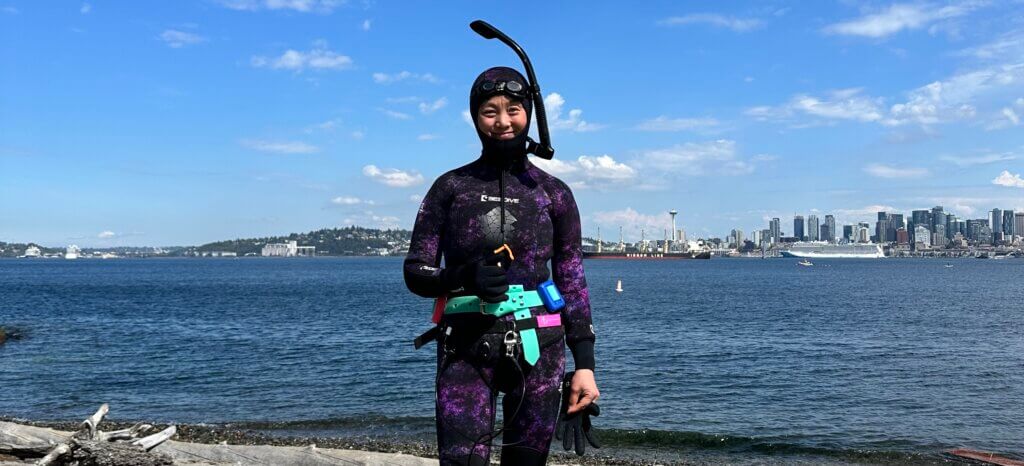
This past weekend, I did something I couldn’t have imagined a year ago: I competed in a two-day freediving competition in the ocean off Seattle.
It was a small, close-knit community. Everyone’s name—athletes, volunteers, and sponsors—was printed on the back of a T-shirt. It felt less like a competition and more like a group of people who were there to support each other, even as we stepped up to compete—with ourselves.
I walked away with a gold medal in CNF (Constant Weight No Fins) at 10 meters. I wanted to be honest about what the gold actually represents: I was the only competitor in that discipline, so it’s not the depth that matters here. It’s about showing up and taking on the challenge.
The more telling moment happened on my second dive, when I attempted my personal best of 15 meters.
I made 15 meters!
And then I got a red card—the judges couldn’t count it because I got the surface protocol wrong. The dive didn’t count as a successful competition dive, and that’s fair. Rules matter.
The result wasn’t what I wanted. But the red card doesn’t erase what happened.
I made 15 meters—the deepest I’ve ever gone. And I learned exactly what I need to work on next time.
Even with a red card next to it, I felt something I want to hold onto: the feeling that everything is possible.
Keep learning—at any age.
I came to freediving as an adult, alongside a career, two kids, and a full life already in motion. There’s a quiet assumption we carry that certain doors close after a certain age. That being a beginner is something we should have outgrown. But maybe being a beginner is exactly what keeps us growing.
Be willing to not be good at something.
This might be the part I appreciate most about freediving.
There are divers around me who can go three, four, even five times deeper than I can. I am very aware of that difference.
And I’m learning to be okay with it.
In so many areas of life, we’re reluctant to start something unless we can imagine ourselves being good at it. We want to be competent, prepared, and reasonably sure we’ll succeed.
Freediving doesn’t really give me that option.
I have to be a beginner. I have to learn slowly. I have to listen to my body. I have to accept that sometimes I can do something today that I couldn’t do yesterday — and sometimes I can’t.
And that’s okay.
Step outside our comfort zone.
I wasn’t racing the diver who went to 50 meters.
I was racing the version of me who, a year ago, wouldn’t have signed up at all.
That’s the comparison that matters to me.
Stepping outside our comfort zone doesn’t always mean doing something dramatic. Sometimes it simply means being willing to be the least experienced person in the room—or on the dive line—and staying anyway.
Competition reveals what comfort hides.
When we’re comfortable, we don’t always find out what we’re capable of.
Competition puts us in a situation where we can’t quite hide away. It surfaces things about our focus, our fear, and our ability to stay present when things don’t go as planned.
A calm Tuesday afternoon doesn’t always reveal those things.
Floating in the water, waiting for the countdown, does.
And that’s part of why I found the experience so valuable.
Keep going.
I don’t know how deep I’ll go next year.
Maybe 15 meters will eventually seem very small to me. Maybe I’ll discover a different limit altogether.
But I know I’ll be back in that water, learning.
Because maybe that’s what I love most about this: not being good at it yet.
Sometimes growth isn’t about pushing harder. Sometimes it’s about learning to stay present when every part of you wants to come back up.
And sometimes, it’s simply about being willing to start something new—and discovering that you are capable of more than you thought.